4H MACD PRICE MOVEMENT RULES

Friday, April 9, 2010

Rule number 1. Your focus should be around the price movement in relations to:

1.1 MA, trendlines, support and resistance levels and big numbers.                                                                            1.2 Then look for the MACD to confirm signals.
2. Homework on price movement should have been done before looking at the MACD signal
3. Don’t take every MACD signal.
4. Don’t jump around ten pairs.
4.1 Stay with the minimum and keep track of their price movement (as stipulated in Rule 9-11)
5. Look at market emotions – candle formation at critical points on the chart will show emotions in the market
6. Wait for playing ground to be removed so that the market can get rhythm and definite direction
7. Go with the rhythm and trend of the pair.
8. Counter trend trade only when:
8.1 Near major Trend, Resistance and Support lines
8.2 RR is 1:1 or better
8.3 Towards the 21MA as profit target
9. When price break through the 89MA, it tends to move back to 21MA and then it moves on in that direction.
10. When price breaks through the 200SMA, it moves back to it before moving on.
11. When price breaks back through the 21MA it comes back to 21MA and then move on to the 89MA
READ MORE - 4H MACD PRICE MOVEMENT RULES

Fibonacci Trading

Saturday, April 3, 2010

The Truth About Fibonacci Trading The truth about Fibonacci levels is that they are useful (like all trading indicators). They do not work as a standalone system of trading and they are certainly not the “holy grail”, but can be a very effective component of your trading strategy.
But who is Fibonacci and how can he help you with your trading?


Leonardo Fibonacci was a great Italian mathematician who lived in the thirteenth century who first observed certain ratios of a number series that are regarded as describing the natural proportions of things in the universe, including price data. The ratios arise from the following number series: 1, 2, 3, 5, 8, 13, 21, 34, 55, 89, 144 ……


This series of numbers is derived by starting with 1 followed by 2 and then adding 1 + 2 to get 3, the third number. Then, adding 2 + 3 to get 5, the fourth number, and so on.


The ratios are derived by dividing any number in the series by the next higher number, after 3 the ratio is always 0.625. After 89, it is always 0.618. If you divide any Fibonacci number by the preceding number, after 2 the number is always 1.6 and after 144 the number is always 1.618. These ratios are referred to as the “golden mean.” Additional ratios were then derived to create ratio sets as follows:
The Truth About Fibonacci Trading
The first set of ratios is used as price retracement levels and is used in trading as possible support and resistance levels. The reason we have this expectation is that traders all over the world are watching these levels and placing buy and sell orders at these levels which becomes a self-fulfilling expectation.


The second set is used as price extension levels and is used in trading as possible profit taking levels. Again, traders all over the world are watching these levels and placing buy and sell orders to take profits at these levels which becomes a self-fulfilling expectation.


Most good trading software packages include both Fibonacci Retracement Levels and Price Extension Levels. In order to apply Fibonacci levels to price charts, it is necessary to identify Swing Highs and Swing Lows. A Swing High is a short term high bar with at least two lower highs on both the left and right of the high bar. A Swingof the high bar. A Swing
8.The Truth About Fibonacci Trading
Low is a short term low bar with at least two higher lows on both the left and right of the low bar.
1.Fibonacci Retracement Levels
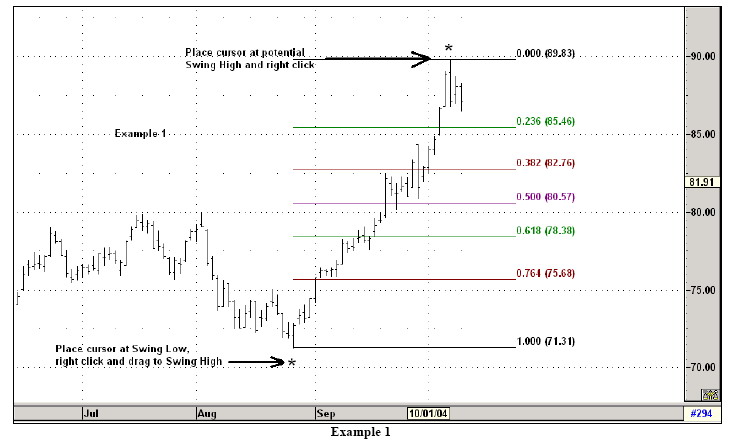
In an uptrend, the general idea is to go long the market on a retracement to a Fibonacci support level. The price retracement levels can be applied to the price bar chart of any market by clicking on a significant Swing Low and dragging the cursor to the most recent potential Swing High and clicking there. This will display each of the Retracement Levels showing both the ratio and corresponding price level. Let’s take a look at some examples of markets in an uptrend. The same points made by these examples are equally applicable to markets in a downtrend.


Example 1: Here we plotted the Fibonacci Retracement Levels by clicking on the Swing Low at about $71.31 and dragging the cursor to the Swing High at about $89.83. You can see the resultant levels plotted by the software. Now the expectation is that if the market retraces from this high it will find support at one of the Fibonacci Levels, because traders will be placing buy orders at these levels as the market pulls back.
The Truth About Fibonacci Trading
                                                            The Truth About Fibonacci Trading

Example 1.1: Now let’s look at what actually happened after the Swing High occurred. The market pulled back right through the 0.236 level and continued the next day through the 0.382 level before finding support. After a few days, the market resumed its upward move. Clearly buying at the 0.382 level would have been a good short term trade.


Example 2: Again, the Fibonacci Retracement Levels were plotted on the chart in the same manner as described in Example 1. Again, we are looking for the market to retrace from the Swing High and find support at one of the Fibonacci levels.


Example 2.1: Now let’s look at what actually happened. The market again pulled back right through the 0.236 level and continued to pull back until it found temporary support at the 0.50 level (a lot of buyers at this level). However, once the buying power was exhausted, the market continued to retrace all the way down to the 0.764 level before resuming its upward trend. In this case, buying at the 0.764 level would have been a good short term trade.
The Truth About Fibonacci Trading
 
The Truth About Fibonacci Trading

Example 3.1: Well, in this case the market found support at the 0.50 level. Buying at this level would have been a great trade as the market gapped up a few days later.
The Truth About Fibonacci Trading

Example 4: Here’s one more example.

The Truth About Fibonacci Trading

Example 4.1: Whoops! The market gapped down through all levels of support and never looked back. A long trade here would have been a loser or at least an open lose position.
You can see from these examples that the market often finds at least temporary support at the Fibonacci Retracement Levels – not always, but often. It should be apparent that there are a few problems to deal with here. First, there is no way of knowing which level will provide support. The 0.236 level seems to provide the weakest support, while the other levels provide support with approximately the same frequency. Second, the market will not always resume its uptrend after finding temporary support, but instead continue to decline below
The Truth About Fibonacci Trading

the last Swing Low. Thirdly, placement of stops is a challenge – it is probably best to place stops below the last Swing Low, but this requires accepting a high level of risk in proportion to the likely profit potential in the trade. Another problem is determining which Swing Low to start from in creating the Fibonacci Retracement Levels. One way is from the last Swing Low as we did in the examples. Another is from the lowest Swing Low of the past 30 days. The point is, there is no one right way to do it, and consequently it becomes a guessing game.


The Truth About Fibonacci Trading

Fibonacci Price Extension Levels
In an uptrend, the general idea is to take profits on a long trade at a Fibonacci Price Extension Resistance Level. The Price Extension Levels can be applied to the price bar chart of any market by clicking on a significant Swing Low and dragging the cursor to the most recent Swing High. Then by clicking on the Swing High and back down to the retracement Swing Low and clicking there. This will display each of the Extension Levels showing both the ratio and corresponding price level. Let’s take a look at some examples of markets in an uptrend. The same points made by these examples are equally applicable to markets in a downtrend.


Example 5: Here we plotted the Fibonacci Price Extension Levels by clicking on the Swing Low at about $38.20 and dragged the cursor to the Swing High at about $47.67 and then down to the retracement Swing Low. You can see the resultant levels plotted by the software. Now the expectation is that if the market continues higher it will find resistance at one of the Fibonacci Levels, because traders will be placing sell orders at these levels to take profits on there long trades.


Example 5.1: Now let’s look at what actually happened after the retracement Swing Low occurred. The market rallied making new highs pausing at the 0.382 level and again at the 1.000 level after a retracement down it rallied again going right through the 1.382 and 1.618 levels. Taking profits at the 0.382 level would have been premature, but taking profits at the 1.000 level would have made a nice trade.
The Truth About Fibonacci Trading
Example 6: Again, the Fibonacci Price Extension Levels were plotted on the chart in the same manner as described in Example 5. Again, we are looking for the market to continue higher before finding resistance at the Fibonacci Levels.
 
The Truth About Fibonacci Trading

Example 6.1: Now let’s look at what actually happened. The market rallied, making new highs and pausing between the 0.382 level and the 0.618 level, and then continued higher. This up move could well continue up to at least the 1.000 level. Taking profits at the 0.382 level would have been premature and only time will tell if taking profits at the 0.618 level was the optimal place to exit the long trade.
The Truth About Fibonacci Trading

Example 7: Here’s another example. Will the market continue higher to one of the Fibonacci Price Extension Levels?
The Truth About Fibonacci Trading

Example 7.1: Well in this case the market found resistance at the 0.382 level which would have been the place to take profits on any long trades
The Truth About Fibonacci Trading

Example 8: Here’s one more example.
The Truth About Fibonacci Trading

Example 8.1: Like the last example, the market found resistance at the 0.382 level which would have been the place to take profits on any long trades.
You can see from these examples that the market often finds at least temporary resistance at the Fibonacci Extension Levels - not always, but often. As in the examples of the Retracement Levels, it should be apparent that there are a few problems to deal with here as well. First, there is no way of knowing which level will provide resistance. The 0.382 level was a good level to cover any long trades in two of the examples, but in the other examples taking profits at that level would have been premature. Another problem is determining which Swing
The Truth About Fibonacci Trading

Low to start from in creating the Fibonacci Extension Levels. One way is from the last Swing Low as we did in the examples; another is from the lowest Swing Low of the past 30 days. Again, the point is that there is no one right way to do it, and consequently it becomes a guessing game.
Alone, Fibonacci Levels will not make you rich. However, Fibonacci Levels are definitely useful as part of an effective trading method that includes other analysis and techniques. You see, the key to an effective trading system is to integrate a few indicators (not too many) that are applied in a way that is not obvious to most observers. All successful traders know it’s how you use and integrate the indicators (including Fibonacci) that makes the difference. The lesson learned here is that Fibonacci Levels can be a useful tool, but never enter or exit a trade based on Fibonacci Levels alone.
Good luck trade
READ MORE - Fibonacci Trading

News Trading

Thursday, April 1, 2010

How do we go about when there is a Secondary setup prior to a news

announcement and when the news comes out the price breaks the trendline. Can we get
involve. The answer is yes but only on a 1min chart with the stoploss determined by the
closest low within the setup. Lets look at an example.
Lets assume that the channel I have marked is prior to a news announcement. Normally the price goes into a tight range just before an important news announcement. That channel on the 15min produces a Secondary level possible move. We still determine our Projected move and that will be the area we will look to take profit. When the price reacts after the news we will be looking at the 1min chart for a pullback and a move past the pullback high and that will be our entry with our stoploss a couple of pips below the low of the pullback. We will then monitor the trade and go to breakeven as soon as the price starts to move into positive territory. The main aim with the go to breakeven is to combat that false breakout where the price runs and then all of a sudden turns around. Our worst case scenario will be to close the trade when it retrace back into the channel or setup. As you can see the risk was about 12pips and the reward 25pips. On Friday the 11th of Dec we had the following news reports.

Prior to that we had a 1hour Secondary level setup. The preparation was the


normal. Projected move was determine as well as max stoploss and profit target and then


the 15min Tertiary level to see if we can get a better stoploss.
When the price break to the top we enter because the higher lows the price made prior to breakout made us anticipated that the price motion was supporting the news that is about to come out. We also got a better stoploss that made the risk:reward better. The price ran to almost the 161%Fib extension and then turned around and really accelerate down. When the price penetrated the Secondary setup we closed for a loss of 20pips. When the price kept on moving down we anticipated that the extend of the news most probably got known before the anouncment that is why the price made a quick
turnaround like that. Because we had our Projected move also marked to the downside we know what to expect. We changed to a 1min timeframe to get an entry on the 1min should the price goes beyond the bottom trendline.


The price broke the bottom trendline then pulled back to the breakout level and when it went down again past the low of the pullback we entered with a 30pip stoploss. The news came out 3min later and confirm the situation of better results then anticipated so we know a run was on the table. We stayed in the trade till the Projected move was reached. We closed after some consolidation. We also must remember the 30pip loss so we had to close for some profit at least. This is a classic example of a false breakout to the top. Another question that must be asked now is. Why will they go all the way to create a false breakout to the top. Remember the Tsunami setup on the beach. Everything on that Secondary level setup looked perfect for a long trade. And then the Tsunami strike. A lot of people as well as we were hit with a loss. But because we had an overall view of the market right in front of us and we have the knowledge of the mafia we were able to spot the turnaround move and run with them. They were accumulating during that Secondary level setup and created a false break to draw some long orders which they know will be picked up much cheaper when the market goes the other way when their stoplosses is hit. If they have gone through all the way as to create a false breakout they surely wants to make some money. That tells me we have not seen the end of this move downwards yet. I want to show you the volumes involved in this whole process we just went through.
The above picture tells an interesting story. Look at the normal daily volume at


first and then the volume become less during the London session until the price broke out


of the Setup. The volume should pick up after the breakout but it even slowed down. That


already tells a story. Are there really some heavy buyers. I don’t think so. That is why we


closed out when the priced pulled back into the Setup. Based on the hindsight volume


analysis we should have closed at breakeven at worst but that is always easy afterwards.


Then the price dropped before the news announcement with heavy volume. The panic


was created and a lot of long positions was picked up when their stoplosses was hit. That


was confirmation of the very strong possibility of an opposite move that was coming. The


result of the coming news will show if the move is in the direction supporting the news.


Indeed it end up to be better news then expected and the direction was to the short side.
Here is another story. It took place about a week before the one we just had a look


at. Why are the volumes much more when the channel top is reached then the volumes


on the channel bottom. If the uptrend is to continue I surely would like to buy at the


bottom of the channel. Why aren’t there a lot of buyers at the channel bottom. Why are


there not a lot of balls handed out at the bottom of the channel. Because the top of the


channel is a better price to hand them out. On the last channel top the volumes was


extremely high. A lot of balls were handed out here. The price also made a higher high


indicating a possible continuation of the uptrend creating a sunny day on the beach just


before the Tsunami struck. Who was willing to sell such high volumes at that level. I am


only asking. Then the drop was quick and all the stops was picked and the balls collected


again for quite a huge down run and money in the bank. They picked up the balls they


handed out at the top of the channel. The above is only my opinion. That is how I


monitor the moves of who they are. I follow volume at certain places to see if I can spot


an exchange of positions and to see if I can spot there moves. If you study this pattern


you will get to the point where you can spot a change in behavior and then position


yourself to be ready to partake with them in the move.
You remember this picture. This is how they do it on the stock markets. In the


down phase they don’t want to be in the market so they get rid of their cookie when the


market is around its top and collect it again when the market is around its bottom. But in


the Forex market where you can go long and short they want to be in the down run as


well. The above scenario we just looked at is how they do it. At the top they hand out


their cookies and when the drop comes they collect the cookie again with short positions.


And then around the bottom they get rid of it leaving the sucker with short positions and


when the sudden recovery starts they collect it again after stoplosses is hit. This is an ever going on cycle over and over again. Doing the same thing over and over.Look at this for getting rid of their cookie and collecting it again when the market turns
around. This was with the credit crunch episode. Big institutions went under with this
whole process. It is not only we as small guys that got hit but there are mafia bigger then banks.
One last example.
Look at the volume increase after we had a long up run on steady volume. That should tell a story to anyone involved in the markets. The cookie was handed over. Are we going to see a down move to the 1.35 again. Only time will tell. As you have seen volumes can play a major role to determine possible direction changes. It normally takes time for them to get rid of their cookies but if we can spot that
we can prepare a plan to be in the move.
READ MORE - News Trading

Market Emotion

Tuesday, March 30, 2010

Market Emotion

The market have certain emotions that when recognized can keep you out of trades when it is not the right time. But it can also make you some nice pips if you can spot the mood. Especially if there is a mood chance taking place from grumpiness to friendliness. If you get home from work and found your wife not in a good mood you surely are looking for trouble when she is not approached properly. A box of chocolates does not work always. But to see the mood change you will know by experience when she can be approached again. That is how well you must know the currency pair you are trading system. You got to know its moods. That can bring you lots of pips and save you a lot of


pain. This conclude the session about money management. Rethink the contents until you fully grasp what is conveyed here. It is much more important than what meets the eye.
D. The Multi level trading system

I want you to look at the next two pages and put the 8 charts in timeframe order from a 1minute, 5min, 15min, 1hour, 4hour, daily, weekly and monthly.
 
The only one that might be recognized is the 1min chart due to its lots of gaps. The rest can be any timeframe. Now look at the next two pages and see which belongs to which
charts.


What was the purpose of this exercise. To show you that the looks of the charts are the same no matter what timeframe you are looking at. That to me tells a story. The way (actions) people buy and sell on a big auction or a small auction is the
same. Whether they are buying the EurUsd on a monthly timeframe or on a 15min timeframe the chart shows the same patterns indicating the same actions. For a person that are trading with a $5million account in the EurUsd on a monthly or weekly timeframe experience the same emotions and make the same decisions as someone on a
$500 account. Those accounts represents what they are prepared to risk for the ability to  make some profit. Both are within an accepted tolerance. If you have a sound strategy
that can take advantage of this concept of human behavior you can make money in any of
those timeframes. That is what the Multi Level Trading System is going to teach you.There is a certain rhythm in the actions people apply when they trade. This
Market Rhythm as I call it can be traced to various vehicles such as stock trading, oil prices, corn prices, commodity prices etc. The human behavior are the same. Look at the
following charts to see the same type of charts as the above.
They represent Oil, Gold, Copper and Soya. You can study other charts to see if  you see the same type of actions.
We are going to exploit this whole human behavior in the MLTS(Multi Level Trading System). You remember our discussion about the Tsunami. Lets look into that human behavior to see if we can recognize some rhythm. If we can see when are they getting rid of their cookie and when are they accumulating cookies we can prepare a
plan..


The above shows exactly how the whole process works on a stock market. We will discus this concept later on a Forex market as it is slightly different because we can trade short as well. Towards the top of the cycle the going is good and the media reports even better. Even after a drop is underway the reporting is a correction and not a drop. When the reporting change to negative confirming the drop the cookie has already been handed over to someone else. The distribution phase is completed. Then starts the preparing for the accumulation phase by the same players waiting for those that they sold the cookie, to get rid of the cookie because the pain of a dropping market makes the pain unbearable. At this accumulation period the reporting is even worse making those that have decided to treat this cookie as a long term investment ( as suggested by some fund
managers) to fear even more and sell. During the drop there are temporary recovery (pullback) phases created. On a bull
run those pullbacks are called profit taking. What are the pullbacks on a bear run called. “loss taking?????”. Just my opinion. There are some risk traders that make money during
pullbacks. What are the possibility of the following scenario.
What would you do if the price is at 100 and there  are very large orders at 70. If those orders presents the truth then I will have to buy above 70 as the price might turn around at that point. The chances of being filled below 70 are then very slim. Be careful for those big orders far away


from the price in a running market up or down.


An order can be withdrawn at any time. What if


those big orders were part of a fake to create a


false up move so that they can get rid of the


cookies they still want to get rid off.
 
What if the sell orders and the large orders were placed by the same people. Who  will benefit from this action. You answer that. During the last stages of the pullback move the large order is removed. When you see that you will know the right direction of the market. This can make you rich especially if you can see orders way down. You and me as small traders will not see the real depth of orders unless we are prepared to pay some big money and fast electronic systems. But it is possible. But then you might be a
mafia yourself. (LOL) It will surely put you on another path if you would be able to see  the whole depth of orders.
Volume play an important role. Large and or low volumes must be at the right places to be interpreted as telling a future story. What I have found is that the mafia wants to leave and enter the scene unnoticed or as quite as possible. That makes it difficult to spot there moves. But if you know what to look for you will see their actions. Lets look at a few examples showing this. What to look for.
 
The above is a MONTHLY chart of the Dow Jones Industrial Index. Just work  through the chart and identify the areas as we have discuss it up to now. We can clearly see how they over months get rid of their cookie and over months buy cookies again at cheap prices. At times at takes years to do so. The question now arise do I have to sit on the sideline for years without getting involve in the market until a big move starts. IF YOU ARE USING A MONTHLEY CHART as your decision mechanism the answer is YES.
The Multi Purpose System got its name from the fact that it allows you to get involve in the market on different timeframes like monthly, weekly, daily, 4hour, 1hour, 15min, 5min and as low down as a 1min. There are 3 multi level timeframes that you choose to work from namely a Primary, Secondary and Tertiary. With the primary level you determine the overall market direction and rhythm(We will discuss the rhythm later). Then on the Secondary level you look for and mark accumulation and or distribution areas like
patterns(triangles, flags, double bottoms etc). Then on the Tertiary you do your entries and determine your stoploss and profit targets. That helps you to spot the overall market condition on a higher timeframe, then identify areas of possible  market moves on a one step lower timeframe and then finally make the entry on another one step lower timeframe that will help you get involve in the market with
smaller candle sizes making stoplosses smaller and more frequent trades possible and still be able to trade in the direction of the Secondary timeframe while keeping the overall Primary timeframe direction and rhythm in mind.
I have used the DJI index just to show it works on any market on any timeframe


on any vehicle whether it be stocks, forex, futures etc.
This is a monthly chart Of the EurUsd showing the major trendlines. Look how  the price continues in the breakout direction after it broke out in Jan1997 and Dec2002 . With the credit crunch in 2008 the market dropped suddenly below the trendline in Oct2008, then made a double bottom and moved up to the trendline, test it, finding resistance against the trendline and bounced off it. We will see if the down move will continue. All I want you to see and understand with this chart is it looks just like a normal 4hour chart with up and down trends. You can now test a weekly, daily, 4h, 1h etc charts and will find the same trendlines with the same patterns like triangles, flags, channels, double bottoms, head and shoulder etc. Now come the nice part.
Should you find a nice pattern like a triangle on a 15min chart you have to make a Multi Level survey . The level you spot the pattern in for a possible move is the Secondary Level timeframe. Then you move one level up for the Primary Level to determine the possible direction of the move as well as the possible projected distance which are anticipated using a Fibonacci 1.61(161%) up to a 1.20(200%) extension. Then you go to one level lower which are the Tertiary Level and you determine your entry point and stoploss as well as your profit target using Fib(Fibonacci) extensions of 1.61 and 1.20 Lets work through an example.
Secondary level
By spotting a nice triangle on the EurUsd 15min chart that now becomes the Secondary level. Now move at least one level up. I prefer to skip the 30min. I don’t use the 30 min at all. When I see a 15min pattern my higher timeframe Primary level is the 1 hour. Lets look at the 1hour.                                                 Primary Level
By using the high and low within the triangle we now determine the possible extend of the move by using Fib 1.61 to 1.20 extension levels and marked that as our possible Projected move. That is where we anticipate the price to move to.                                                                      Secondary level

Now we move back to our 15min Secondary level to set our max. stoploss and determine our profit target. The ratio will always be a 1:1 situation. By moving to the next lower timeframe(in this case the 5min) the Tertiary level we will determine if we can hop on board with a smaller stoploss with still the same profit target as with the Secondary level. That will improve our Risk to Reward ratio a lot if that can be
achieved.
The main thing to remember here is the stoploss. That is determined by the closest high to the possible breakout. Then that is used to determine the profit target as well. The
reason I set the 1.61 level as well is because sometimes you will find the projected move will be much further down then the profit target. If that is the case you do want to give
your position a chance to proceed to the projected move level and when the price goes below the 1.61 level you can set your position to breakeven and then use a manual trail to
follow the price to the projected move level or you can take some profit at the 1.61 level and give the remainder a chance to go to the projected move level. The choice is yours. Lets move to the Tertiary level to see if we can get on board with a better stoploss then the one we determined in the Secondary level chart.
Tertiary level the entry level
Now we have moved to the Tertiary to wait for the entry point to be reached and to pull the trigger but the most important part here is to see if we can get a better stoploss scoring a few pips that will make our Risk:Reward better.
As you can see we could use a lower stoploss level that resulted in 16pip risk and  a 22pip reward where the original one was a 23pip risk with a 23pip reward. When price reach the 1.61 Fib level then partial profit may be taken or all set to breakeven etc. to give the position a chance to run if it wants to. Our main objective with the Tertiary level is to obtain a better stoploss level that will enhance our risk to reward ratio. If there is no lower stoploss level then use the original one as set in the Secondary level. Lets look at another example.
Secondary level

We spot a potential trade on the 5min chart. It can break both directions so we
will have to do our analysis on both directions.
Primary Level

One level up to the 15min to determine the Projected move.
Secondary level

Back to the secondary level to determine the profit targets and max. stoplosses for both directions.
As you can see we make provision for a break in any direction. Tertiary level the entry level
We got a 1pip better entry and the profit target was reached. The projected move  was also reached so the +9pips could be stretched.
 
Above is a schematic presentation of the events as per Level.
READ MORE - Market Emotion

Horloge pour site Orologio per sito

News


Followers

Total Pageviews

ukraine brides contatore visite website counter
powered by PRBbutton
SEO Stats powered by MyPagerank.Net